A London childhood
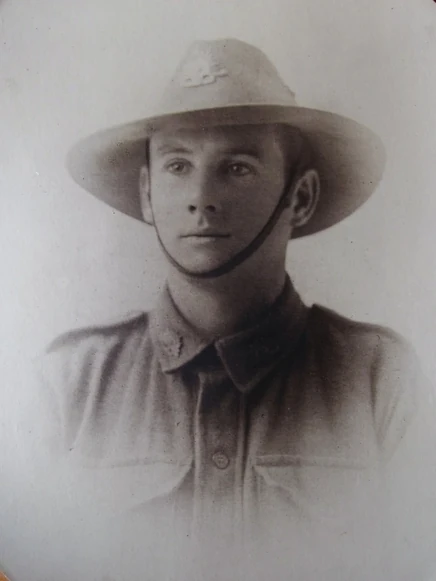
William Henry Comper was born on 6 June 1889 in Gower Street, St Pancras, the first child of William Dossetter Comper, a chemist who later worked as a stockbroker’s clerk and accountant, and Emma Wraight, who had grown up by the sea at Folkestone. Two daughters followed: Emma Mary Elizabeth, always called Bessie, and Alice Sarah, always called Dolly.
Emma never took to London. The family would escape the cramped streets of Camden Town to walk on Hampstead Heath with their fox terrier, Spot. They sang together in the evenings, and Harry played the violin. In 1904, when he was fourteen, his mother died of cancer.
He was schooled at the Wesleyan Middle-Class School in Falkland Road, Kentish Town, and passed its highest examination. For a year he kept the house and looked after his sisters while studying part-time. One of the masters at these small private schools was a notorious bully; after the man had been particularly unjust to a classmate, Harry gave him a good hiding. As a young man he worked for a large London contracting firm, making deliveries with a horse and cart.
Orphaned
On 28 March 1907 Harry, then seventeen, walked into the breakfast room at home and found his father dead. An inquest followed, and the death was reported in the English papers over the following weeks. Harry, Bessie and Dolly never spoke of it again, and took the silence to their graves.
Their mother had left a wish that if anything happened to their father the children should go to her brother Henry, who farmed in Australia. Until they could sail, an unmarried aunt took them in at Torquay.
To Australia
The three of them left London on the Miltiades on 30 October 1907, travelling third class. Harry, eighteen, gave his occupation as clerk. They reached New South Wales on 13 December, and made the last of the journey inland by bullock cart, fording rivers, to their uncle’s farm at Goonellabah near Lismore.
On the voyage out Harry had shared a cabin with a young man named Green Hall, who was bound for New Zealand. Green and Dolly wrote to one another for two years, and were married on New Year’s Eve 1909. They settled at Havelock North in Hawke’s Bay. After their uncle died in 1911, Harry and Bessie worked their cousin Maurice Wraight’s farm, Cheriton, at Chilcott’s Grass near Lismore. In 1913 Bessie went to New Zealand to be near her sister, and stayed.
The teacher at Limpinwood
Harry trained as a teacher in Sydney in 1912. The following year he became the sole charge teacher at Limpinwood School, on the Tweed River — the only teacher of a small country school in the valley above Murwillumbah.
He kept up a correspondence with the principal of his old school in London, and arranged for the children of Limpinwood to write to the children of Falkland Road, telling them what life in Australia was like. The Falkland Road school magazine reported that Harry had introduced a good many of its customs into his school “up country from Sydney”.
He kept horses, as a man covering a country district had to. In October 1914, two months into the war, he wrote to Bessie that he had just completed two years of teaching and was looking forward to a rise and a bigger school the following year, and that he was beginning to think it would be nice to settle down. He became engaged to Victoria Bell, of Chillingham, a few miles down the valley.
The first of November, 1915
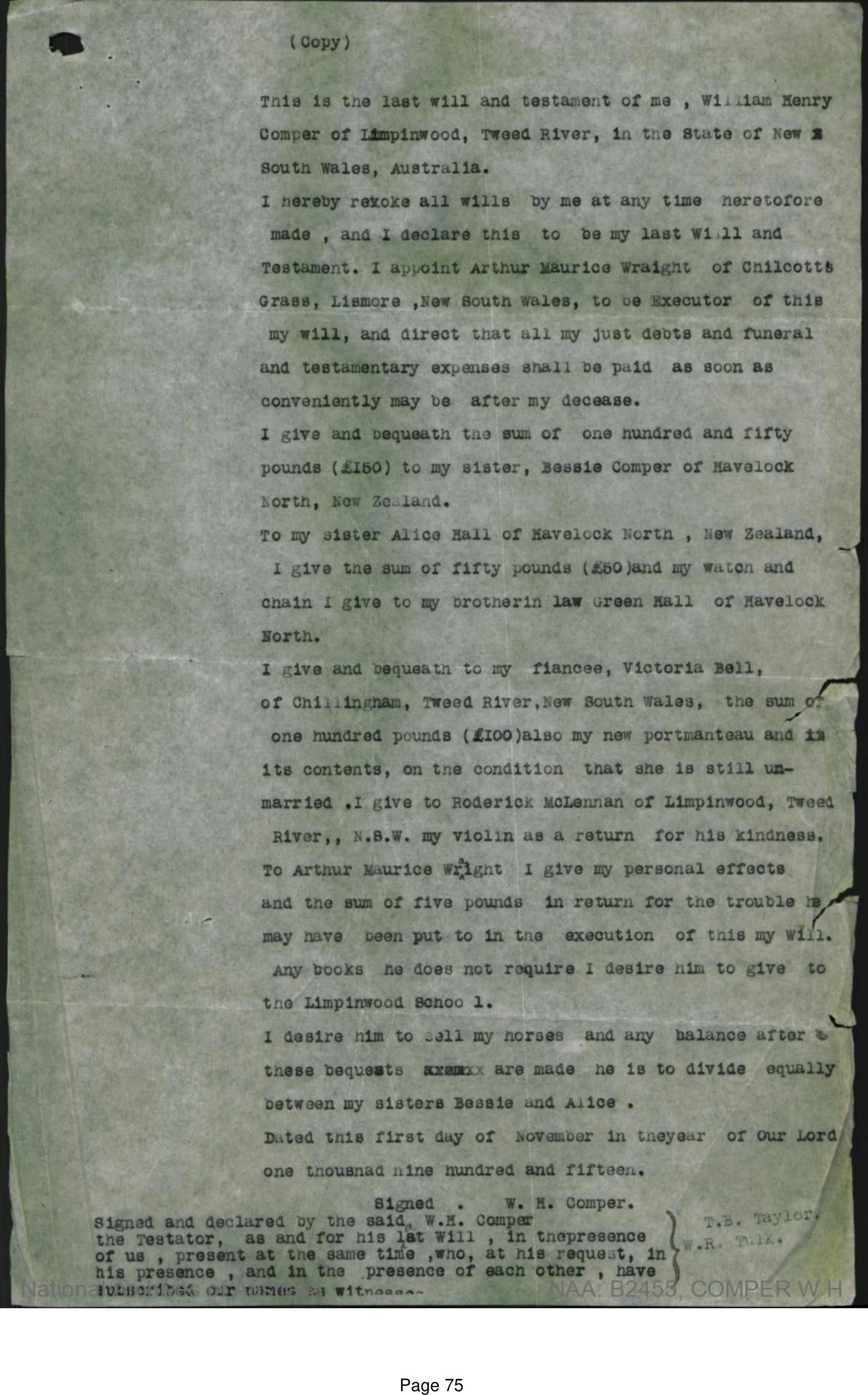
On 1 November 1915 he made his will.
He left £150 to Bessie and £50 to Dolly, and his watch and chain to Dolly’s husband. He left £100 to Victoria Bell, with his new portmanteau and everything in it, “on the condition that she is still unmarried”. He left his violin to Roderick McLennan of Limpinwood, “as a return for his kindness”. He asked that his horses be sold. And he directed that any of his books his executor did not want should go to the Limpinwood School.
Two days later he travelled to Brisbane and enlisted as a private. He was 26, five feet seven and a half inches tall, and weighed a hundred and twenty-five pounds. He had tried to enlist once before and been turned away as under the standard. This time they took him.
From private to officer
He was made corporal on 1 March 1916 and sergeant a month later, in A Company of the 42nd Battalion — part of the 11th Brigade of the 3rd Australian Division. On 5 June 1916, the day before his twenty-seventh birthday, he sailed from Sydney aboard HMAT Borda, reaching Southampton on 23 July.
The 3rd Division trained through the English summer at Larkhill on Salisbury Plain, where it was paraded before the King. Harry, on the right flank, got a good look at him, and wrote home that George V looked very worried, and that his greying beard did not make him look any younger. In August and September Harry studied at the School of Instruction at Chelsea Barracks.
In November the division crossed to France, and on 23 December the 42nd went into the front line for the first time, at Armentieres. They spent a hard winter there. On 29 January 1917 Harry was promoted company sergeant major, the senior non-commissioned soldier in his company. Thirteen days later, on 11 February, he was shot through both arms.
He was carried back through a field ambulance and a casualty clearing station to hospital at Wimereux, and from there shipped to England aboard the hospital ship Cambria. A cable went to Bessie in New Zealand to tell her. He spent weeks in hospital at Colchester, then pushed to be sent back — presenting himself on parade, telling them he was quite fit, and getting himself marked A class. He had no interest, he wrote, in a soft job.
He rejoined his battalion on 30 April, and marched fifty-two miles with them to training without a man of his company falling out. On 7 June the 42nd fought its first major battle, the assault on Messines Ridge. The 3rd Australian and New Zealand Divisions lost 377 officers between them, and men like Harry had to step up to fill the gaps. On 18 June he was told he was to be commissioned second lieutenant, with No. 15 Platoon of D Company. “A good platoon,” he wrote, “think we shall hit it alright. Have to win my spurs.”
His army notebook from that summer records the ordinary misery of the line — the rain, the mud, the lice, a dugout that was blown in three minutes after he left it, tobacco running out. He wrote to his sisters instead about swimming in a river, and the plums, and the village children. He never mentioned the hardships to them. He signed his letters to Bessie, whom he called Puss, with the words that gave his great-niece the title of her account of him: Now, so long, sister mine.
Zonnebeke, 4 October 1917
The front was quiet on the night of 3 October. The moon was full until the wind changed, and soon after midnight it began to rain. All night the men filed along the infantry tracks towards their jumping-off tapes, crossing the swampy bed of the Zonnebeke valley on duckboards where the shelling had left any. By four in the morning the 11th Brigade lay waiting on the wet ground on Hill 40, packed into a strip barely ninety metres deep.
Zero hour was six o’clock. There was to be no preliminary bombardment; the Germans were to be taken by surprise. As it happened they had planned to attack at dawn themselves, and their barrage came down first, half an hour early.
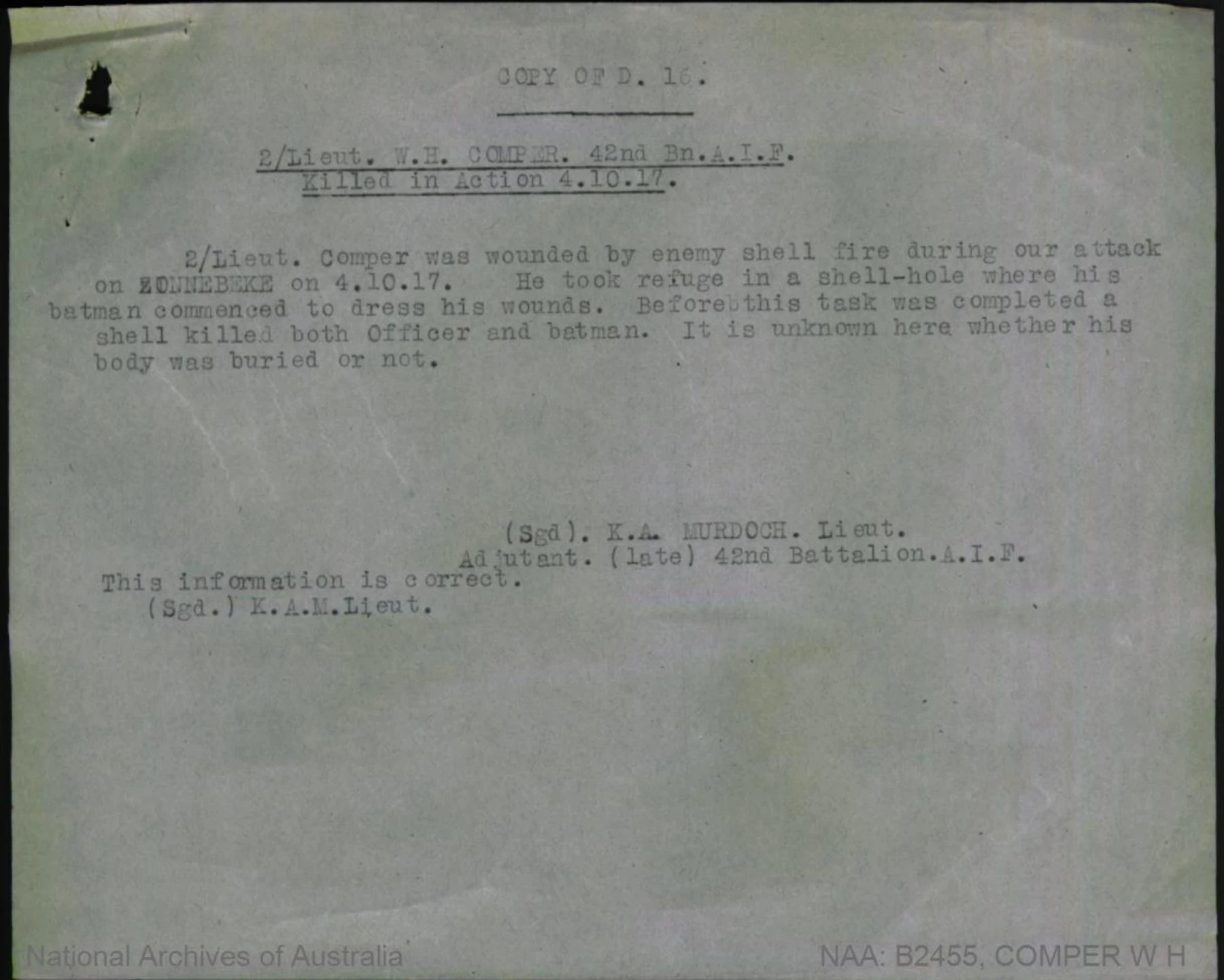
When the Australian barrage fell at six the battalions went forward into it. On the right, a machine gun opened up from a pillbox near Zonnebeke station. It was in that attack, before Hill 40 was crossed, that Harry was hit — he had been trying to pull an injured man out of the line of fire. What followed is recorded in the report his battalion’s adjutant wrote afterwards: